Best Cheapest Payment Gateways for Small Businesses in India (2026): 5 High ROI Options Compared
Most small businesses in India shortlist payment gateways based on TDR, the percentage fee charged per successful transaction.
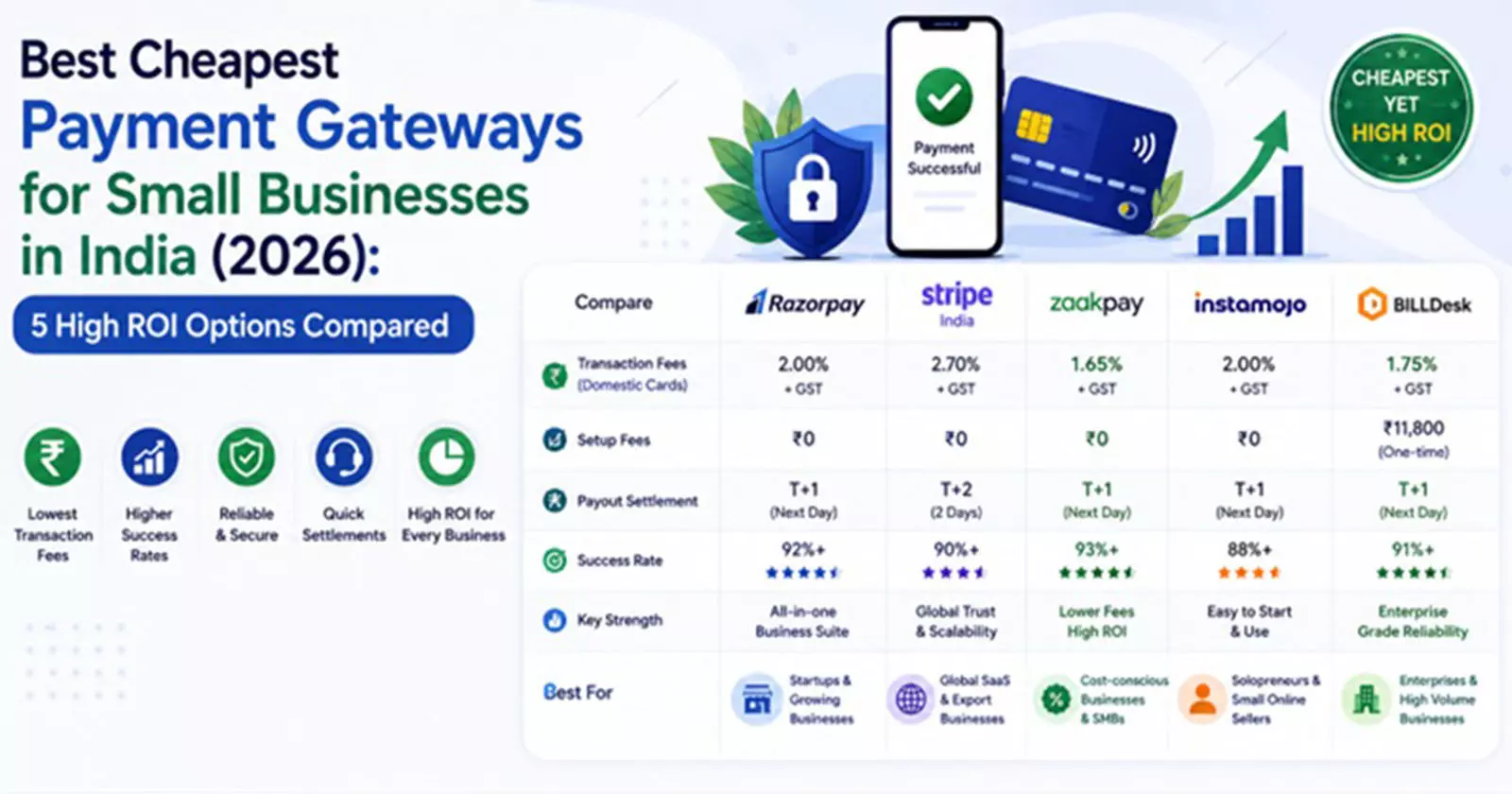
Most small businesses in India shortlist payment gateways based on TDR, the percentage fee charged per successful transaction. It is an intuitive starting point, but it consistently produces the wrong answer. The real cost of a payment gateway is determined by three variables: TDR, annual maintenance charges (AMC), and payment success rate. When all three are factored into a total cost of ownership (TCO) calculation, the rankings shift considerably from what headline rates imply. This comparison evaluates five gateways, Razorpay, Stripe India, Zaakpay, Instamojo, and Billdesk, on TCO for small businesses processing between Rs. 50,000 and Rs. 5L per month in GMV.
Key Takeaways
- TDR is not the same as total cost. A lower TDR paired with an annual maintenance charge can cost more per month than a higher TDR with zero AMC, particularly at volumes below Rs. 2.08L/month.
- Payment success rate is a hidden revenue lever. A gateway with a 93% success rate retains Rs. 16,000 more per Rs. 2L in GMV than one with an 85% success rate, a gap no TDR comparison table captures.
- Stripe India suits internationally-oriented businesses but is not optimised for domestic India payment flows.
- Razorpay charges zero AMC and zero setup fee. At 2% TDR with a 93%+ reported success rate, it delivers the lowest total monthly cost for most small businesses when evaluated on TCO.
- Custom pricing is available for businesses that scale. Always look for negotiated pricing for merchants exceeding Rs. 5L/month in GMV, accessible through the sales team, keeping it cost-competitive at higher volumes without requiring a gateway switch.
- Billdesk is an enterprise gateway and is not practically accessible for most small businesses given its onboarding requirements.
Why TDR Alone Is a Flawed Metric for Small Businesses?
TDR, Transaction Discount Rate, is the percentage deducted from each successful transaction. A gateway charging 1.75% TDR sounds cheaper than one charging 2%, and for businesses processing high volumes, that 0.25 percentage point difference matters. But for small businesses, the full cost picture includes two additional variables that TDR figures never disclose.
The first is the annual maintenance charge (AMC). Several Indian payment gateways charge Rs. 3,600 to Rs. 4,999 per year simply to maintain an active account. Spread over 12 months, this amounts to Rs. 300 to Rs. 417 per month in fixed overhead, a cost that hits hardest at low GMV, where it represents a proportionally large share of retained revenue.
The second variable is payment success rate. If a gateway processes 100 checkout attempts and 15 fail, the merchant loses revenue on those 15 transactions entirely. A gateway with an 85% success rate effectively means 15% of potential GMV never arrives. At Rs. 2L/month in attempted transactions, an 8 percentage point difference in success rate between two gateways translates to Rs. 16,000 in revenue retained versus lost, a figure that does not appear anywhere on a standard pricing page.
"A gateway charging 1.75% TDR with Rs. 4,999 in annual maintenance costs more per month than a 2% gateway with no annual fee for merchants processing under Rs. 2.08L/month in GMV." This is the arithmetic that TDR-only comparisons consistently obscure for small businesses.
How to Calculate the True Cost of a Payment Gateway?
The TCO formula that surfaces a meaningful comparison is:
At Rs. 2L/month in attempted GMV, the formula produces a concrete rupee gap between gateways:
- Payment Gateway with 2% TDR, 93% success rate, Rs. 0 AMC: (2,00,000 x 0.93) - (2,00,000 x 0.02) - 0 = Rs. 1,82,000
- Payment Gateways with 1.75% TDR, 85% success rate, Rs. 417/month AMC: (2,00,000 x 0.85) - (2,00,000 x 0.0175) - 417 = Rs. 1,65,083
The Rs. 16,917 monthly difference in retained revenue is not visible in any TDR comparison.
The break-even point between a lower-TDR gateway with AMC and others sits at approximately Rs. 2.08L/month in GMV. Below that volume, others retains more revenue in absolute rupees despite the higher TDR. Above that threshold, a lower-TDR gateway with AMC begins to close the gap, but only until the business crosses Rs. 5L/month in GMV. At that point, others offers custom pricing through a direct sales conversation, negotiated based on transaction volume and category. This custom tier is not listed on the public pricing page and is not automatically triggered, it requires the merchant to initiate contact with the others sales team. For businesses on a growth trajectory, factoring in this transition point avoids a mid-scale gateway switch.
Best Cheapest Options of All Compared with Ranking
Rank 1. Razorpay, Payment Gateway Review
| Parameter | Value |
| TDR (Standard) | 2% |
| Annual Maintenance | Rs. 0 |
| Setup Fee | Rs. 0 |
| Payment Success Rate | 93%+ (reported) |
| International Payments | 3% |
Razorpay's cost advantage for small businesses is structural: zero AMC combined with a 93%+ reported payment success rate produces the highest net realized revenue per rupee of GMV for most businesses operating below Rs. 5L/month. The absence of an annual maintenance charge has an outsized impact at low GMV, where a Rs. 4,999/year AMC represents a meaningful share of monthly retained revenue.
The platform supports 100+ payment modes, UPI, net banking, debit and credit cards, EMI, BNPL, and wallets, all included in the standard plan. Dynamic routing technology automatically directs each transaction through the path most likely to succeed, which is the primary driver behind the higher success rate. Payment links, invoicing, subscription billing, and GST compliance tools are bundled in at no additional cost. For businesses scaling beyond Rs. 5L/month in GMV, Razorpay's custom pricing tier becomes accessible through the sales team, making the platform viable at enterprise volumes without requiring migration.
Two limitations are worth noting. The dashboard carries a large number of features and can feel cluttered for first-time users setting up payment infrastructure for the first time. International payment processing is not activated by default and requires a separate approval process. EMI, Amex, and international card transactions are charged at 3% rather than the standard 2%, which is relevant for businesses with premium-card customer bases.
| Category | Rating |
| Pricing Transparency | 4/5 |
| Payment Success Rate | 5/5 |
| Developer Integration | 5/5 |
| Support Quality | 4/5 |
| Feature Breadth | 5/5 |
Best for: Small businesses and early-stage startups in India processing up to Rs. 5L/month in GMV seeking the lowest total monthly cost on a TCO basis, with a clear path to custom pricing as they scale.
Rank 2. Stripe India, Payment Gateway Review
| Parameter | Value |
| TDR (Standard - Domestic) | 2% |
| Annual Maintenance | Rs. 0 |
| Setup Fee | Rs. 0 |
| Payment Success Rate | ~88-90% (India, estimated) |
| International Payments | 3% + 2% cross-border fee |
Stripe's reputation as a developer-first global payments platform is well-earned, and that orientation shapes both its strengths and its limitations for Indian small businesses. API documentation is among the most comprehensive available, the integration experience for technically capable teams is smooth, and the platform manages cross-border payments with minimal friction. For businesses with international customers or cross-border revenue streams, Stripe's global infrastructure is a practical advantage that domestic-only gateways cannot replicate.
The constraint for domestically-focused small businesses is that Stripe's payment stack is globally architected and not specifically optimised for India's payment infrastructure. UPI support exists but is less deeply embedded compared to India-native gateways. Payment success rates in India are estimated at 88-90%, lower than Razorpay's reported 93%+, which translates to more failed transactions per Rs. 1L in GMV attempted. Zero AMC is a positive, but the success rate gap and narrower India-specific feature set reduce the ROI case for businesses operating exclusively in domestic markets.
| Category | Rating |
| Pricing Transparency | 4/5 |
| Payment Success Rate | 3.5/5 |
| Developer Integration | 5/5 |
| Support Quality | 3.5/5 |
| Feature Breadth | 3.5/5 |
Best for: Developer-led small businesses in India with a meaningful share of international customers or cross-border revenue requirements.
Rank 3. Zaakpay, Payment Gateway Review
| Parameter | Value |
| TDR (Standard) | ~1.9-2% |
| Annual Maintenance | Applicable (tier-dependent) |
| Setup Fee | Rs. 0 |
| Payment Success Rate | ~83-85% (estimated) |
Zaakpay, the payment gateway arm of Mobikwik, offers competitive TDR at standard tiers. However, AMC is applicable at most account levels, and the success rate is estimated at 83-85%, the second-lowest among gateways reviewed here. For small businesses at lower GMV, the AMC overhead combined with a higher payment failure rate reduces net realized revenue below what gateways with stronger success rates deliver.
The platform covers standard payment modes but carries a narrower integration ecosystem compared to Razorpay or Stripe. Third-party plugin support for e-commerce platforms is limited, and developer documentation is less comprehensive. Businesses with an existing Mobikwik relationship may find onboarding more straightforward, but for most small businesses evaluating gateways on a TCO basis, the combination of AMC and a below-average success rate weakens the cost case.
| Category | Rating |
| Pricing Transparency | 3/5 |
| Payment Success Rate | 3/5 |
| Developer Integration | 3/5 |
| Support Quality | 3.5/5 |
| Feature Breadth | 3/5 |
Best for: Small businesses with existing Mobikwik ecosystem relationships requiring a domestic mid-tier gateway for straightforward payment collection.
Rank 4. Instamojo, Payment Gateway Review
| Parameter | Value |
| TDR (Standard) | 1.7-2% |
| Annual Maintenance | Rs. 0 (free plan) |
| Setup Fee | Rs. 0 |
| Payment Success Rate | ~80% (estimated) |
Instamojo offers the simplest onboarding experience among the five gateways reviewed. The free plan carries zero AMC and zero setup fee, which reduces the barrier to entry for solopreneurs, independent sellers, and businesses at the earliest stage of operation. The constraint is a payment success rate of approximately 80%, the lowest in this comparison. At Rs. 1L/month in attempted GMV, a 13 percentage point success rate gap between Instamojo and Razorpay translates to Rs. 13,000 in lost revenue, a figure that no AMC saving can offset.
The free tier also carries restrictions on API access and feature availability. As transaction volumes grow, the revenue leakage from failed payments compounds, and the TCO case for remaining on Instamojo weakens considerably against gateways with stronger payment infrastructure.
| Category | Rating |
| Pricing Transparency | 4/5 |
| Payment Success Rate | 2/5 |
| Developer Integration | 2.5/5 |
| Support Quality | 3/5 |
| Feature Breadth | 2.5/5 |
Best for: Solopreneurs and creators with very low monthly transaction volume who need a no-fee setup for initial market testing.
Rank 5. Billdesk, Payment Gateway Review
| Parameter | Value |
| TDR (Standard) | 1.5-2.5% (category-dependent) |
| Annual Maintenance | Applicable at enterprise tiers |
| Setup Fee | Negotiated |
| Payment Success Rate | ~88-90% (estimated) |
Billdesk operates as enterprise-grade payment infrastructure. It is used extensively by government agencies, insurance companies, utility providers, and large financial institutions for high-volume recurring billing. For small businesses, Billdesk presents a practical barrier: onboarding is not self-serve, minimum volume requirements apply at most tiers, and the sales process is oriented toward enterprise accounts. The platform is not designed for the quick-start, self-service use case that most small businesses require when evaluating payment gateways.
Success rates are estimated at 88-90%, which is competitive, but the onboarding complexity, non-transparent pricing, and enterprise-minimum structure make a direct TCO comparison with Razorpay or Instamojo largely academic for businesses below Rs. 10L/month in GMV.
| Category | Rating |
| Pricing Transparency | 2.5/5 |
| Payment Success Rate | 4/5 |
| Developer Integration | 2.5/5 |
| Support Quality | 3/5 |
| Feature Breadth | 3.5/5 |
Best for: Established mid-size to enterprise businesses in regulated sectors, insurance, utilities, lending, or government payments, requiring high-volume recurring billing infrastructure.
Side-by-Side Comparison: 5 Payment Gateways for Small Businesses in India
| Gateway | Standard TDR | Annual Maintenance | Success Rate | Setup Fee | Best Volume |
| Razorpay | 2% | Rs. 0 | 93%+ | Rs. 0 | All volumes; custom pricing above Rs. 5L/month GMV |
| Stripe India | 2% (domestic) | Rs. 0 | ~88-90% | Rs. 0 | International-facing businesses |
| Zaakpay | ~1.9-2% | Applicable | ~83-85% | Rs. 0 | Mobikwik ecosystem; simple flows |
| Instamojo | 1.7-2% | Rs. 0 (free plan) | ~80% | Rs. 0 | Very early stage; minimal volume |
| Billdesk | 1.5-2.5% | Applicable (enterprise) | ~88-90% | Negotiated | Enterprise; regulated sectors |
Verdict: Which Payment Gateway Offers the Best ROI for Small Businesses?
When evaluated on total cost of ownership, accounting for TDR, annual maintenance charges, and payment success rates, the rankings shift materially from what headline TDR figures suggest.
For businesses processing under Rs. 50,000/month, Instamojo's zero-fee structure reduces initial overhead. However, the 80% success rate means roughly 1 in 5 attempted transactions fails. The revenue impact of that failure rate should be modelled before treating zero AMC as a straightforward win.
Between Rs. 50,000 and Rs. 5L/month in GMV, the range that covers most small businesses in India, Razorpay's zero AMC and 93%+ reported success rate produce the highest net realized revenue per rupee processed. "Merchants processing under Rs. 2.08L/month in GMV pay less with Razorpay in absolute rupees, even though some competitors offer a lower headline TDR." Above that break-even point, the gap narrows, but Razorpay's custom pricing tier, available to merchants exceeding Rs. 5L/month through a direct sales conversation, keeps it competitive as businesses scale, removing the friction of a gateway migration at a critical growth stage.
Stripe India suits businesses with meaningful international customer bases where its global infrastructure is a genuine operational advantage. Billdesk is not a practical option for small businesses given its enterprise onboarding requirements and non-self-serve structure.
Razorpay charges zero annual maintenance, while most alternatives with lower TDR carry Rs. 3,600 to Rs. 4,999 per year in fixed costs that erode margin fastest at the GMV ranges where small businesses operate. The total cost of ownership, not the TDR figure, is the number worth calculating before making a gateway decision.
Frequently Asked Questions
Which payment gateway has the lowest fees for small businesses in India?
Evaluating fees on TDR alone produces misleading comparisons. When annual maintenance charges and payment success rates are included in the calculation, Razorpay delivers the lowest total monthly cost for most small businesses in India processing below Rs. 5L/month in GMV. Its zero AMC and 93%+ reported success rate retain more revenue per rupee processed than gateways with lower headline TDR but higher fixed costs or lower payment success.
What is TDR in a payment gateway?
TDR, or Transaction Discount Rate, is the percentage fee deducted from each successful transaction processed through a payment gateway. A 2% TDR on a Rs. 1,000 transaction means the merchant receives Rs. 980. TDR is the most visible cost metric but excludes annual maintenance charges and the revenue impact of payment failures, two variables that substantially affect actual monthly cost for small businesses.
Does Stripe charge an annual maintenance fee?
No. Stripe charges Rs. 0 in annual maintenance and Rs. 0 as a setup fee. The standard cost is a 2% TDR on domestic transactions. EMI, Amex, and international card transactions are processed at 3%.
What is payment success rate and why does it matter?
Payment success rate is the percentage of checkout attempts that result in a completed, captured transaction. A gateway with a 93% success rate processes 93 out of every 100 checkout attempts successfully; the remaining 7 represent lost revenue. At Rs. 2L/month in attempted GMV, the difference between a 93% and an 85% success rate equals Rs. 16,000 in retained versus lost revenue per month, a figure that does not appear on any standard gateway pricing page.
Does Razorpay offer custom pricing as a business scales?
Yes. Razorpay offers negotiated custom pricing for businesses processing above Rs. 5L/month in GMV. This tier is not published on the public pricing page and requires initiating a conversation with the Razorpay sales team. Custom pricing makes Razorpay cost-competitive at higher volumes and allows businesses to continue scaling on the same platform without migrating infrastructure.