10 silent GST Mistakes That Can Invite Scrutiny Notice
10 silent GST faults that might prompt a scrutiny notice, and a complete guide to how you can avoid them
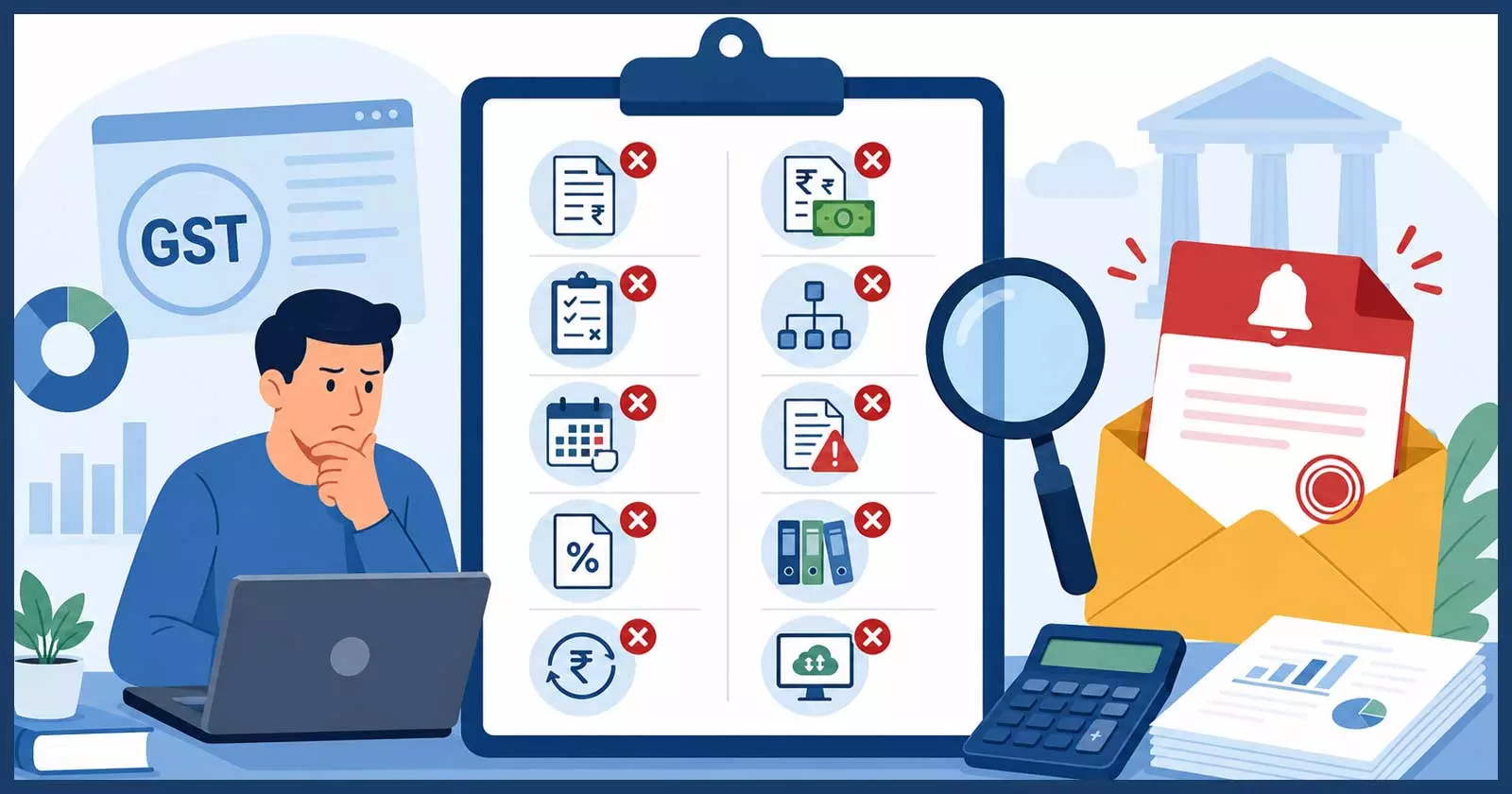
India's Goods and Services Tax (GST) regime has been highly digitised since its introduction. GST Network (GSTN) has sophisticated data analytics and artificial intelligence, which can identify mismatches in real-time. In taxation, the order of the day is no longer manual audits. If you make a single discrepancy in your GST returns today, you will immediately receive a scrutiny warning from the tax authority.
It’s not just about submitting returns on time. For business owners and compliance officers, remaining off the GST radar is equally important. It takes a good eye. Unfortunately, many taxpayers make silent mistakes that are inadvertent and are red lights for the system.
10 silent GST faults that might prompt a scrutiny notice, and how you can avoid them
1. Discrepancy between GSTR-1 and GSTR-3B
This is the most prevalent reason for GST inspection. GSTR-1 is your outward supply return and GSTR-3B is your summary return. If the total taxable value filed in GSTR-1 is different from the total taxable value filed in GSTR-3B, the system will immediately flag it. With the advent of GSTR-2B (auto-populated inward supply data), monthly reconciliation of these two reports is not an option anymore, it is a survival technique.
2. Ignoring GSTR-2B Reconciliation
GSTR-2B is a dynamic statement that shows the InputTax Credit (ITC) available to a taxpayer based on the GSTR-1 filed by his suppliers. Most of the firms claim ITC on the basis of their purchase invoices without examining whether their supplier has actually uploaded those invoices in their GSTR-1. Filing ITC claims without corresponding GSTR-2B data is a sure-shot approach to get a scrutiny notice.

Still handling Trusts & NGO compliance with scattered resources? Don't wait until a client asks a question you can't answer. Grab your copy today
3. Claiming ITC on Personal or Exempt Goods
As per GST rules, one cannot claim Input Tax Credit on goods or services used for personal use or for making exempt supplies. Businesses often claim ITC wrongly on expenses incurred for staff welfare, motor vehicles for personal use, and on club memberships. The algorithm of GSTN keeps a watch on the nature of expenses, and any unauthorised claims of ITC are quickly reported.
4. Round-Tripping of ITC
The round-tripping is a situation when a group of related companies prepare bogus invoices amongst themselves only to pass on and claim Input Tax Credit without any actual movement of goods or services. The GST analytics system can readily find out the circular trade patterns and the closed loops of transactions in a network, which results in immediate suspension of GSTINs and tight scrutiny.
5. Late Filing of Invoices in GSTR-1
As per GST rules you are required to record an invoice in the GSTR-1 of the month in which the invoice is issued or by the due date of return for the month of issue. Many companies delay reporting invoices to control cash flow or to defer tax responsibilities to later months. The system cross-checks the invoice date with the filing date, and any regular delays will generate an automated alarm.
6. Filing Nil Returns but Running a Business
A business with no external supply (nil GSTR-1 and GSTR-3B) for consecutive months but continuing to spend expenses and claim ITC, or while maintaining active bank transactions is a huge red flag for the GST department. If you are in a real business lull, it is better to file a proper return rather than a nil return to avoid being tagged as a dormant or shell firm.
7. Inconsistency or lack of justification Reverse Charge Mechanism (RCM) Payments
The tax is payable by the recipient of goods/services under the Reverse Charge Mechanism (RCM). Many enterprises do not pay RCM liabilities under Section 9(3) and 9(4) of the CGST Act or pay it in piecemeal manner. Also, some taxpayers do not reverse the RCM ITC claimed in the same month of payment as required by law. This produces a data discrepancy that the system readily detects.
8. Non-filing of Annual Returns (GSTR-9) and Reconciliation Statements (GSTR-9C)
Most taxpayers think that the monthly returns are the end of their compliance journey and do not know about the annual filing requirements. The non-filing of GSTR-9 and GSTR-9C (for enterprises with sales over ₹5 Crores) not only attracts substantial late fees but also puts the business on the high-risk list. Annual Return is where the department expects the books of accounts to match perfectly with the monthly GST data.
9. Frequent Changes in Core Business Profile
Frequent changes in your primary business activities, adding or removing directors/partners or updating the principal place of business without valid reasons make your GST profile look unstable. Fraudsters tend to hijack GSTINs and modify the credentials. To counter this, the GST system highlights profiles with frequent revisions and sends them for manual review to check the authenticity of the firm.
10. A High Percentage of Zero-Rated or Exempt Supplies Without Economic Justification
If you are in the business of taxable items, but suddenly there is a huge rise in zero-rated exports or exempt supplies, the system will take note. Honourable enterprises do change their business strategies, but this is a common way to avoid tax liability. If there is a big change in your supply mix you should have good documentation (shipping invoices for exports, for example) to support the change at the time of assessment.
How to Protect Your Business from GST Scrutiny
To avoid these quiet mistakes, you need a change from “compliance for the sake of filing” to “compliance through reconciliation”. Here are three excellent practices to start using today:
- Automate Reconciliation: No more excel sheets to match GSTR-1, GSTR-2B and GSTR-3B. Buy a good GST compliance program which points up discrepancies before filing.
- Supplier Communication: Create a business policy to conduct business exclusively with complying suppliers. If the supplier is not filing their GSTR-1, your ITC is in danger and recurrent affiliation with non-compliant suppliers will adversely affect your compliance score.
- Have Perfect Documentation: Every ITC claim must be supported by legitimate documents such as tax invoice, delivery challan (in case of transportation of goods) and evidence of payment.### Conclusion
The GST department is moving from audits that are reactive to data tracking that is proactive. The 10 silent GST mistakes mentioned above are not mere administrative errors but are seen by the system as possible triggers for tax evasion. Get a grip on the complexities of ITC eligibility, concentrate on monthly reconciliation, and ensure your filings are regular and precise, and your business will not only be compliant but also totally off the radar of investigation.
Support our journalism by subscribing to Taxscan premium. Follow us on Telegram for quick updates