India-EU FTA: Implications of the ‘Mother of All Deals’ for the Share Market
The India-EU “Mother of All Deals” is already being factored into equity markets not merely as a policy event but as a sector-specific earnings catalyst.
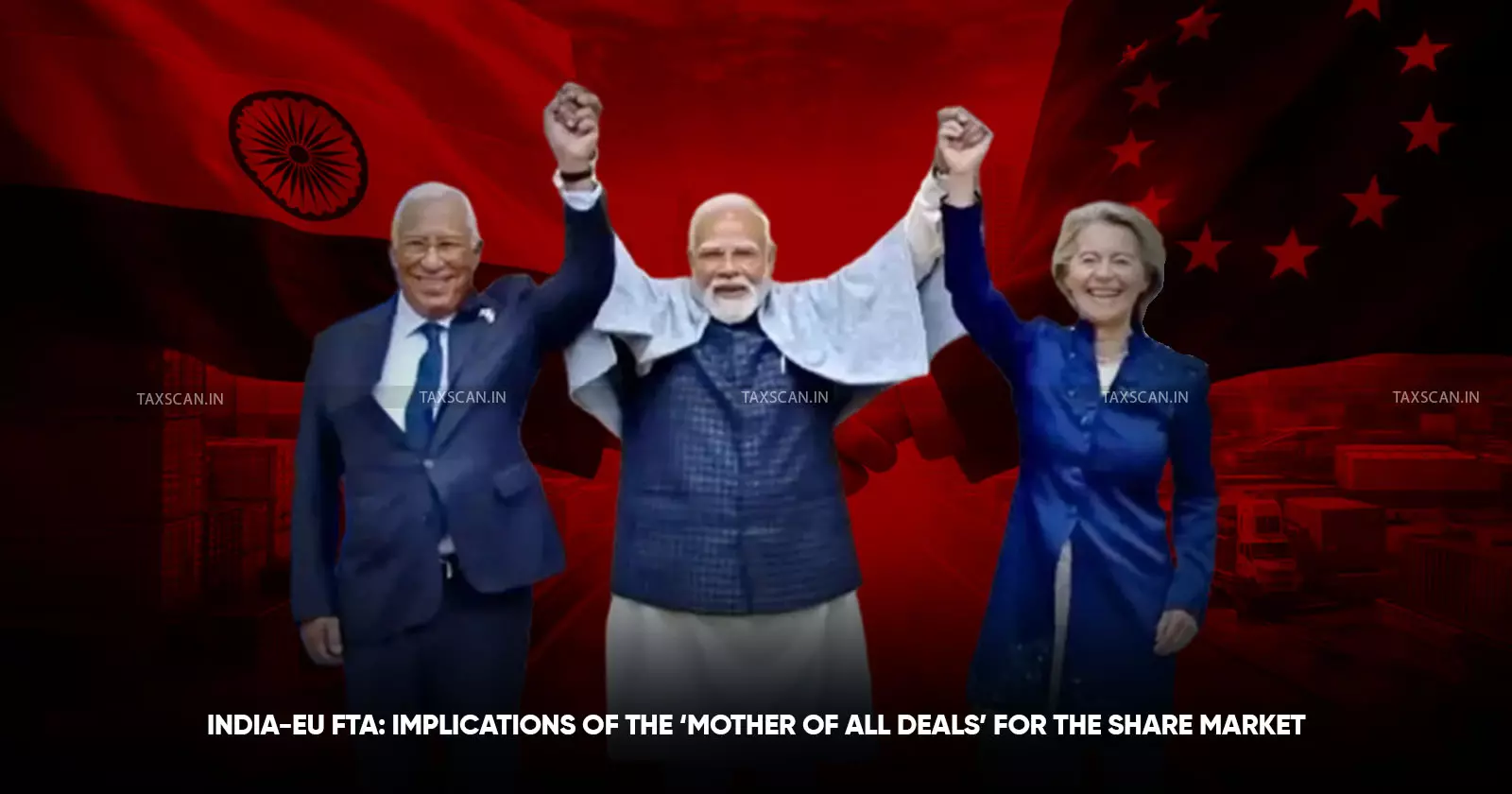
On January 27, 2026, the European Union (EU) signed a significant Free Trade Agreement (FTA) with India, referred to as the 'Mother of All Deals' represents a major turning point in global trade policy. The agreement plans for a great deal of tariff reduction and elimination between the two countries. The pact eliminates a total of 90% traffic imposed on Indian exports to EU forecasts an expansion of bilateral trade from about $136.5 billion to $250 billion by 2031, boosting long-term investor confidence in Indian markets.
The FTA has already had a profound impact on India's equity markets, with different sectors experiencing different levels of effect, as investors try to determine how the new agreement will improve the competitiveness, profit margins, pricing power, and long-term earnings visibility for listed companies. This analysis examines the possible effects on the share prices based on recent market movements within different sectors following the conclusion of the FTA.
Market Reaction and Sectoral Divergence
Indian Market exhibited limited gains following the FTA announcement in the light of reciprocal reductions in duty on EU products, primarily in automobiles and industrial machinery sector, resulting in competitive pricing pressure on domestic manufacturers which could compress both their operating margins and their earnings estimates.
The rise of both the BSE Sensex and the Nifty 50 was modest and indicative of broad investor confidence in the long-term outlook for overall trade expansion, both domestically and internationally. However, individual equity responses were heterogeneous:
Financial and Energy Sectors: The Financial and Energy markets soared after the announcement of the FTA. Banks such as HDFC Bank and ICICI Bank were up about 1.5% due to a positive outlook for cross-border financing, trade credit flows and the resiliency of corporate balance sheets. In addition, the energy sector was also a great performer, with ONGC rising approximately 6.3% and Oil India increasing by about 8%, showing excitement in tariffs as well as global trends for commodities.
Export-Oriented Manufacturing - Textiles, Apparel, Leather and Gems & Jewellery: Although sectors like Textiles, Apparel, Leather, and Gems and Jewellery are labour-intensive and usually account for a significant amount of Indian exports, they are also currently positioned as some of the main beneficiaries of the FTA through zero-duty access to the EU. With tariffs as low as 4% and as high as 17%, this zone is able to compete on a much better footing than non-FTAs within the world's largest market.
Chemicals, Pharmaceuticals and Industrials: Due to tariff reductions on machinery and equipment from the EU, chemical and pharmaceutical companies will experience increased production capacity and competitive price advantages. These two industries are expected to see good price appreciation.
Autos and Auto Components: Share price reactions in the automobile sector have been mixed. Several automobile companies' stocks fell as a result of concerns about increased competition from imported vehicles due to possible tariff decreases over time.
Subsequently, analysts fear that domestic automobile makers will be negatively impacted in the short term, especially when many of the automobile brands being sold in India by European companies are being manufactured locally or through assembly operations and will have little-to-no import tariff advantage over the next few years.
IT, Metals, & Other Services: Europe and India’s FTA is unique in how it also opens access to services markets, enabling improved commercial engagement between EU and India by increasing access to 102 Indian and 144 EU sub-sectors within financial and professional service categories.
For example, large publicly traded Indian IT firms such as HCL Technologies, Tata Consultancy Services and Coforge are all considered as indirect beneficiaries to this FTA, as they have large revenues generated from the EU and will likely benefit from less regulatory friction. Similarly, large Indian metals / mining companies have been identified as potential beneficiaries in terms of long-term export growth. However, the growth of these exporters is restrained by market demand in other parts of the world.
Consumer, FMCG, & High-End Imports: Individual consumer stocks reacted differently after the announcement of the agreement, with company portfolios like Asian Paints and Hindustan Unilever performing poorly, as a result of cautious investor views on their ability to increase consumer spending, competition from foreign imports, as well as the potential volatility of currency fluctuations.
Premium European import sectors e.g., luxury cars and imported wines showed mixed performance as well; however, they were also negatively impacted by currency factors like the depreciation of the Indian Rupee against the USD which added to disappointing sales and profits for many stockholders of these companies.
Regulatory Certainty
The FTA provides an environment of policy stability and predictability which produces a level of legal certainty regarding access to markets and supports longer-term capital allocation decisions. In turn, this will help firms with an exposure to trade with the EU may reduce their regulatory risk premiums, which enables a longer-horizon valuation model by improving the longer-term returns on their investments in capital equipment.
The FTA provides a long-term uplift to trade flows but the short-term reaction of markets has been measured. The ultimate impact of the India-EU FTA on the share price will be determined by the introduction of phased tariffs and the execution of earnings revisions in companies’ financial performance.