Resident Buyers Can Deposit TDS on Immovable Property Purchases from Non-Residents via PAN-Based Challan: Budget 2026
The proposal seeks to simplify compliance by removing the requirement for resident buyers to obtain a TAN for depositing TDS.
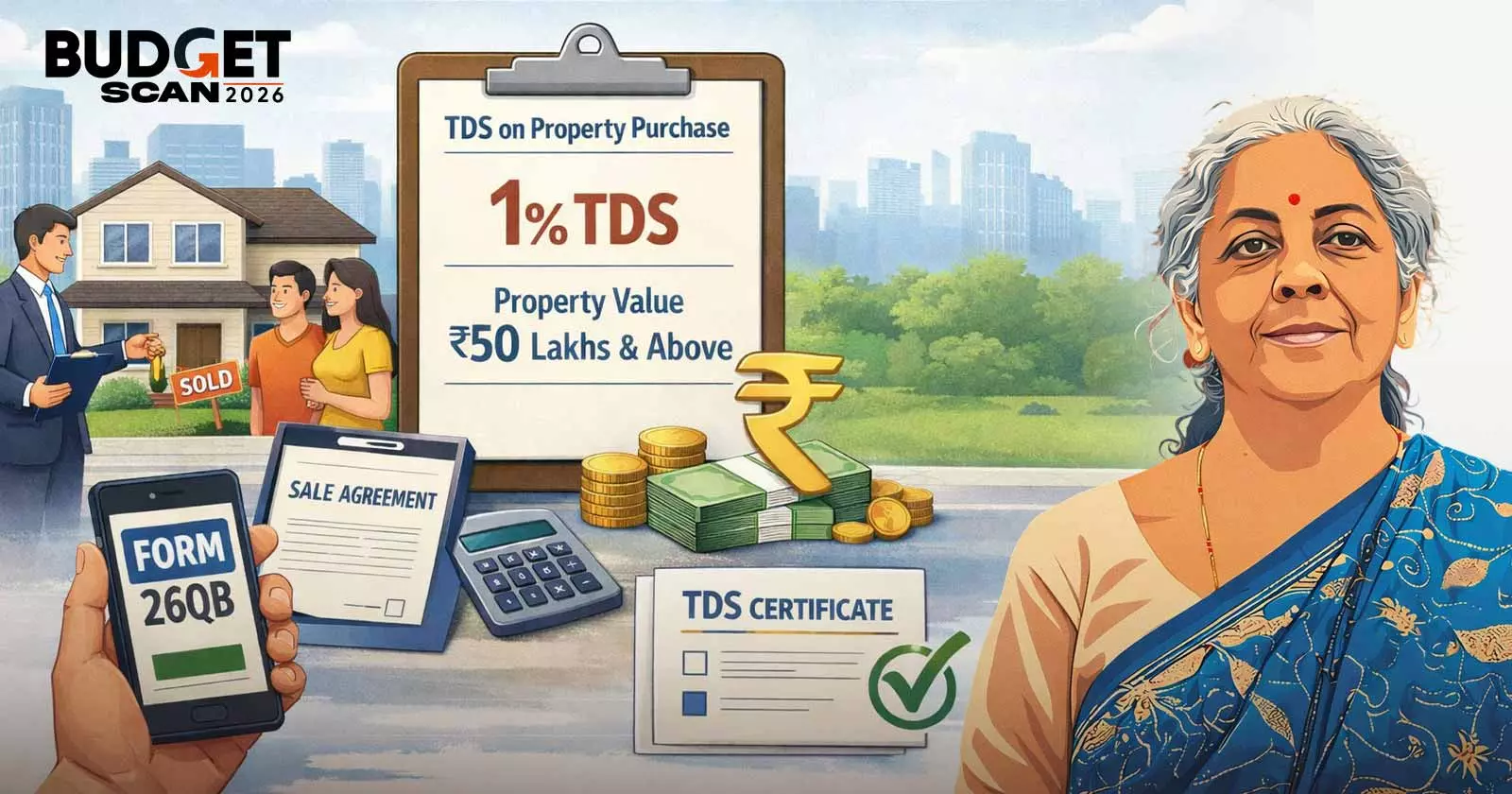
The Union Budget for the financial year 2026-27 was presented by Finance Minister Nirmala Sitharaman in the Lok Sabha on Sunday, February 1, 2026.
Numerous announcements were made by Minister Sitharaman pertaining to the direct tax regime, particularly to simplify compliance and reduce procedural hurdles.
Also Read: Union Budget2026-27: Key Highlights [Read Finance Bill 2026]
Notably, the Budget announced that resident buyers purchasing immovable property from non-residents will be able to deposit Tax Deducted at Source (TDS) using a PAN-based challan.
The proposal was introduced in Part B of the 2026 Budget pertaining to improving ease of compliance under the income tax framework.
The existing system requires resident buyers to obtain a Tax Deduction and Collection Account Number (TAN) for depositing TDS deducted on payments made to non-resident sellers, even where the transaction is a one-time property purchase.
To address this compliance hurdle, the new Budget proposes a mechanism that allows resident buyers to deposit the deducted TDS through a PAN-based challan, thereby eliminating the need to obtain a TAN for this limited purpose.
The change comes as a relief for compliance for individuals who are otherwise not required to deal with regular TDS obligations.
Sitharaman stated that the reform is in sync with the continuing objective of reducing unnecessary procedural requirements while minimising taxpayer interface with the tax administration.
Also Read: Budget 2026: No Change on Income Tax Slabs and Standard Deduction
Considering that the issuance and holding of a PAN is a common requirement for resident taxpayers, this change reduces unnecessary compliance for occasional high-value transactions such as property purchases.
The Budget proposal does not alter the rate of TDS or the underlying liability; it only simplifies the manner in which the deducted tax is deposited with the government.
The government is expected to release details on the operational aspects of the PAN-based challan mechanism, including its format, process flow and timelines through relevant rules or notifications.
Support our journalism by subscribing to Taxscan premium. Follow us on Telegram for quick updates