

Residential vs Commercial Property Under GST: Rental Income Taxability, RCM & ITC Explained
The Article explores the critical nuances concerning the GST Applicability on Rental income.
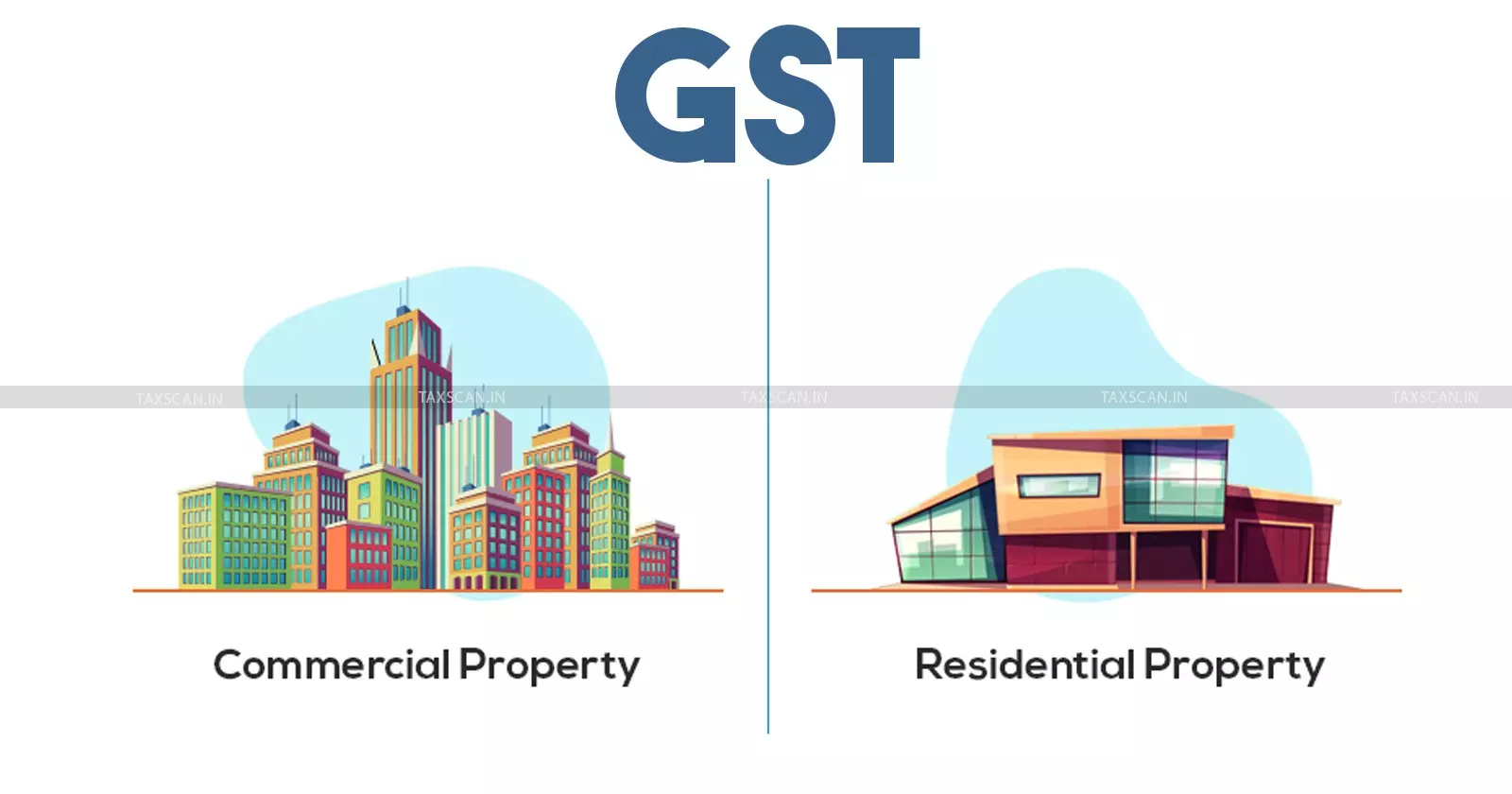
According to India's Goods and Services Tax (GST) system, whether rental income from properties is taxable will depend heavily on how these are classified and how they are intended to be used. While commercial properties rented out for business purposes are subject to an 18% GST, residential properties rented out for living can qualify for broad exemptions under some limits. It is important for landlords to know the differences between these two types of properties so that they comply with the law and do not accidentally incur any taxes on the rental income.
There are two main exemptions to the general GST rules for residential rentals. The first is that under GST Notification No. 12/2017-Central Tax (Rate), any rental of a residential dwelling for the purpose of using it as a residence is exempt from GST. The purpose of this exemption is to ensure that basic housing costs are not included under GST, thereby keeping compliance costs lower for individual landlords and ensuring that affordable rents continue to be available.
Know the complete aspects of tax implications of succession, Click here
The scope of this exemption, however, is quite limited. The rental property has to be residential and rented to a tenant for residential use. If this dual requirement has not been satisfied, GST becomes payable. Therefore, if a residential unit is rented by a tenant to operate as an office, coaching centre or guest house, even though the nature of the unit is residential, then it fails to fall under the exemption from GST in that case.
18% GST Liability on Commercial Properties
A Taxable Service for the Purpose of GST is Renting Commercial Property at 18%, i.e, 9% CGST + 9% SGST or 18% Inter-State GST. Office, retail, warehouse, industrial and other properties rented for business purposes all fall under this service.
As per the GST's Service Accounting Code (SAC) 997212 "Renting or Leasing of Own/Leased Non Residential Property", Rent to Lease Non Residential Properties has an 18% GST Rate for the Total Rental Value including Maintenance Charges, Service Charges and Any Other Fees Charged by the Landlord.
Registration and Compliance Thresholds
Landlords must register for GST once their Aggregate Annual Rental Income exceeds ₹20,00,000 (₹10,00,000 for Certain States). This Registered Amount consists of total rental income from all Commercial Properties in India.
Once a Landlord is registered he/she must issue a GST Compliant Invoice that must contain the following Mandatory Information: GSTIN of Both Parties, Invoice Number & Date, Description of Services, Taxable Value, Applicable GST Rates, and Total Breakdown of CGST, SGST, and IGST.
If the Landlord's Rental Income falls within the Small Sales Tax Limit or Registration Type, the Landlord would be required to upload the invoices on the GST Portal, as well as to file Monthly or Quarterly Returns based on Turnover/Registration.
For Landlords close to the ₹20 lakh threshold for turnover, Voluntary Registration may provide benefits and benefits to Landlords as it is compliant with the compliance obligations of being registered. By registering, the Landlord can charge GST at the Forward Charge, rather than requiring the burden of tax shifting to the Tenants through the Reverse Charge Mechanism, when negotiating with Tenants who prefer registered suppliers.
What Is the Reverse Charge Mechanism (RCM)?
The Reverse Charge Mechanism (RCM) represents a major departure from the standard GST Collection process. Instead of having the supplier or landlord remit the GST on behalf of the customer/tenant, the customer/tenant will make direct payment to the government. RCM applies when a registered tenant rents property from an unregistered landlord. This is outlined in Notification No. 13/2017-Central Tax (Rate). By applying this rule, compliance with tax requirements occurs even if the service provider's taxable sales fall below the registration threshold.
Some examples of when RCM would apply are:
- When a residential property is rented for residential purposes: No GST applies, regardless of whether the landlord is registered for GST under the law or below the minimum threshold for registration.
- When a residential property is rented for commercial use: If the Landlord is not registered with GST and the tenant is registered, the tenant must remit the GST under RCM. The exemption does not apply to commercial activity.
- When a Registered Tenant rents a Commercial Property from an Unregistered Landlord: The Registered Tenant must remit the GST liability under RCM. If the Landlord is registered with GST, then the Landlord charges the GST under the "forward charge."
An implication of RCM adding complexity to Commercial Lease Negotiation is that Registered Tenants must keep track of whether their Landlords are registered for GST, as this determines whether they are responsible for the tax liability. This complexity will increase as both Landlord and Registered Tenant work together to ensure compliance with regulations.
Prohibition against Claiming Input Tax Credits (ITC)
The prohibition under Section 17(5)(d) of the CGST Act 2017 states that ITC on the construction of immovable property shall not be available to Landlords although the property will eventually generate taxable rental income. Therefore, Landlords cannot offset any GST they paid as part of their input costs to construct the property against the GST they are liable to collect on their commercial rentals.
The Functionality Test
As a result of a landmark decision by the Supreme Court of India in Safari Retreats Case (2024), the "Functionality Test" was developed to determine if a building qualifies as a "Plant" instead of an immovable property. Whether a building is classified as Plant or immovable property is very important since Input Tax Credit restrictions apply to immovable property but not to Plant and Machinery.
A building will be classified as a Plant if it is constructed specifically to support a specific Business Purpose and is essential to the continued operation of that business beyond providing passive shelter. The structure must provide functional utility that is integral to the business activity provided in the Business Plan.
Practical compliance framework
- Monitor Turnover on an ongoing basis : Track the aggregate annual rental income from all commercial properties so as to determine when the ₹20 lakh threshold has been crossed, thus necessitating registration.
- Clearly Identify the Use of Property: Lease agreements must explicitly state whether property is residential or commercial and specify intended use. Ambiguity can lead to disputes over GST applicability and liability allocation.
- Mixed-Use Rentals: Mixed-use rental properties include both commercial and residential use. Rent associated with a mixed-use rental property is apportioned. Only the commercial portion of the rent is subject to GST (Goods and Services Tax). You will need to document your process of apportionment based on how you apportion the rent, such as by using floor area, room count, or actual usage patterns.
Special Considerations for Furnished Rentals and Ancillary Services
a) Where the landlord provides furnishing, cleaning, repairs, maintenance, and/or utility services with the rental of the property, these services are typically composite supplies. The GST implications for composite supplies are determined by the principal (dominant) service being provided. For example, where the rental of the property is the principal service, that is where the GST implications would apply.
b) Short-term rental platforms such as Airbnb blur the line between residential and commercial rental properties. If the short-term rental property is essentially being used as accommodation at the same rate as hotel accommodation, the rental property may also be considered a commercial accommodation; therefore, GST may be applicable even though the short-term rental property is housed in a residential building.
c) Providing shared office space for flexible seating arrangements, shared facilities and bundled services of furnished office space clearly creates GST implications. However, the interpretations of Advance Ruling Authorities vary by state for such arrangements.
d) Generally speaking, refundable security deposits do not constitute taxable values for GST purposes. Therefore, if the refundable deposit is adjusted against the rental amount or if the deposit is not refundable, the deposit may be subject to GST.
Landlords need to understand how to navigate the framework of property classification, intended use, registration thresholds, compliance obligations, and how they can be impacted by the Reverse Charge Mechanism, which places the liability for GST taxation on the Tenant in specific scenarios. The limitations on ITC will restrict the Landlord's ability to offset any construction costs to be offset against Rental Income, except for the narrow plant exemption.
Support our journalism by subscribing to Taxscan premium. Follow us on Telegram for quick updates
