Supreme Court Hears PIL Challenging Income Tax Act 2025 Powers to Search Digital Devices, Cloud Servers & Virtual Digital Space
The Supreme Court heard a PIL challenging Income Tax Act 2025 provisions allowing searches of digital devices and cloud data and adjourned the matter for further consideration.
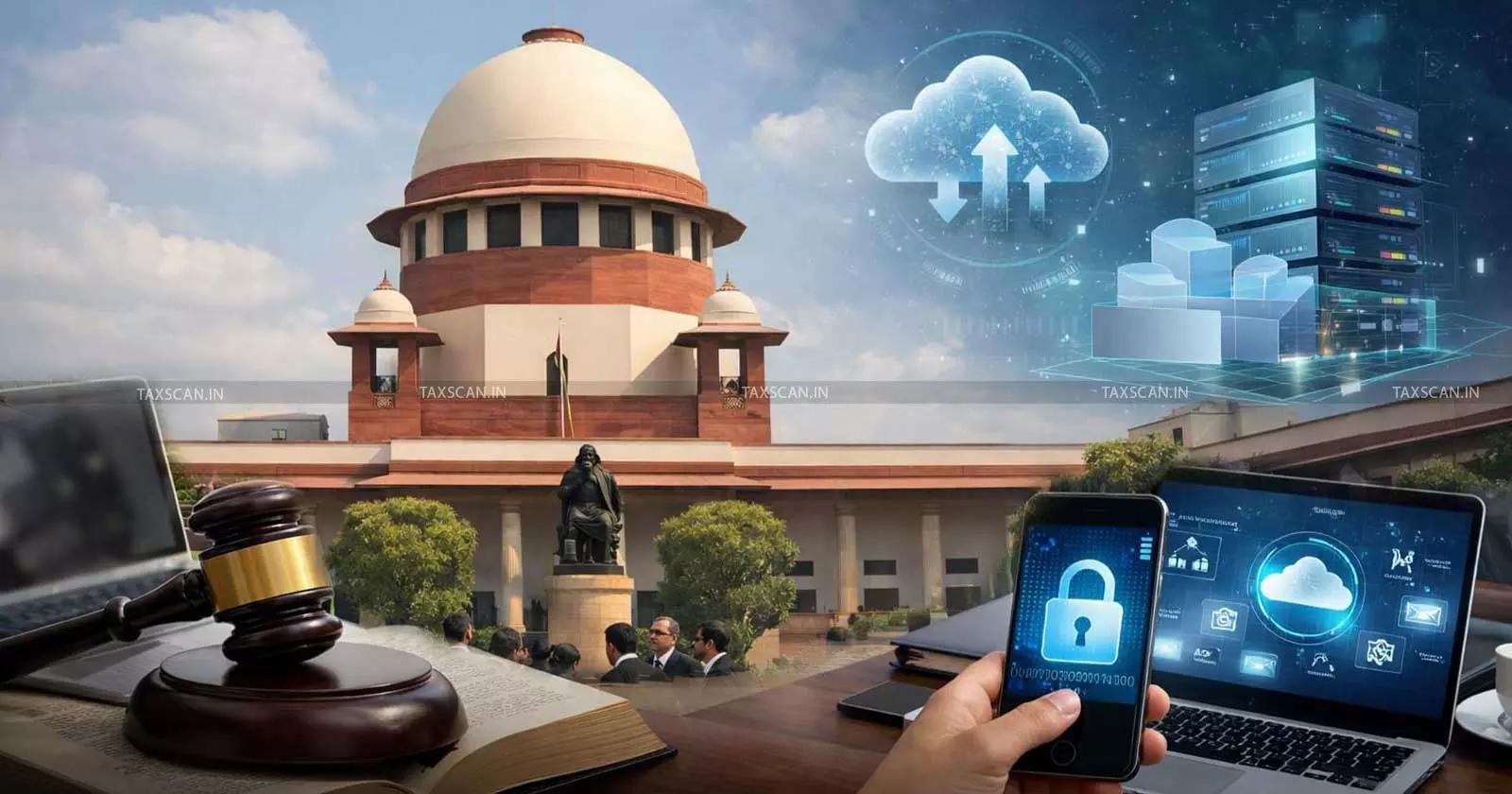
The Supreme Court of India is examining a public interest litigation that challenges the constitutional validity of provisions in the Income Tax Act, 2025 which allow Income Tax authorities to search “computer systems” and “virtual digital space” including personal digital devices, cloud servers, and electronic communications.
The case has been filed by entrepreneur Vishwaprasad Alva W.P.(C) No. 114/2026, a PIL challenging Income Tax Act 2025 provisions allowing searches of digital devices and cloud data, and adjourned the matter for further consideration., which is scheduled to come into force from 1 April 2026. The petitioner has also challenged the corresponding provisions under Section 132 of the IncomeTax Act, 1961, on which the new law is based.
According to the petitioner, the impugned provisions permit highly intrusive searches of digital devices such as laptops and mobile phones, as well as access to emails, private chats, cloud-stored data, and other electronic information without any prior judicial approval. The petition states that this amounts to a serious invasion of informational privacy protected under Article 21 of the Constitution.
The petitioner has also challenged clauses which permit search and seizure based on a belief that a person “will not” or “would not” produce documents if summoned, or that assets “would not be disclosed” for tax purposes. They argued that these clauses create an “anticipatory search” framework, where search powers can be exercised even without any existing violation of tax law.
The petition states that less intrusive mechanisms such as summons, surveys, and assessments already exist under the law, and allowing full-scale digital searches on speculative grounds fails the test of proportionality.
Another major ground of challenge is the absence of safeguards. The petition points out that search authorisation is granted internally by senior tax officials, and the “reasons to believe” forming the basis of a search need not be disclosed even to appellate tribunals. The counsel argued that this secrecy makes meaningful judicial review difficult and violates principles of natural justice, especially when search powers are extended into the digital domain.
Also Read:Employer Loan Tax Rule in Income Tax Rules Draft 2026: SBI Rate Method Explained
The matter was briefly heard by a bench comprising Chief Justice of India Surya Kant, Justice Joymalya Bagchi, and Justice N.V. Anjaria. Senior Advocate Sanjay Hegde, assisted by Advocate-on-Record Pranjal Kishore, appeared for the petitioner.
The counsel argued that although Section 132 of the Income Tax Act was upheld by the Supreme Court in Pooran Mal v. Director of Inspection in 1974, that decision requires reconsideration after the recognition of the right to privacy as a fundamental right in K.S. Puttaswamy v. Union of India in 2017.
Justice Bagchi observed that limited judicial review of search actions under Section 132 has already been recognised by the Supreme Court in Principal Director of Income Tax (Investigation) v. Laljibhai KanjiBhai Mandalia in 2022. He explained that courts can examine whether there is a rational nexus between the material available with the authorities and the belief recorded for initiating a search. He also pointed out that provisions allowing searches based on apprehension of non-compliance exist to prevent destruction of evidence.
During the hearing, the bench discussed the nature of digital evidence and the possibility of its destruction. Justice Bagchi explained that much digital evidence is stored on devices or in the cloud, and without search powers, investigations could be frustrated. Chief Justice Surya Kant observed that the power is not uncontrolled, as it operates subject to pre-conditions, and added that the challenge is based on apprehension at this stage. He stated that the manner of implementation would also be relevant.
The bench asked the petitioner’s counsel to examine the Mandalia judgment in detail and address how far it answers the concerns raised in the present case. The matter was adjourned for further hearing next week.
Support our journalism by subscribing to Taxscan premium. Follow us on Telegram for quick updates