Who Really Pays the Tax When India's Farms Move Their Goods? Inside GST's Quiet Burden on the Buyer
From the farm gate to the GST portal, securing tax credits now requires buyers to issue their own paperwork and pay the government in cash
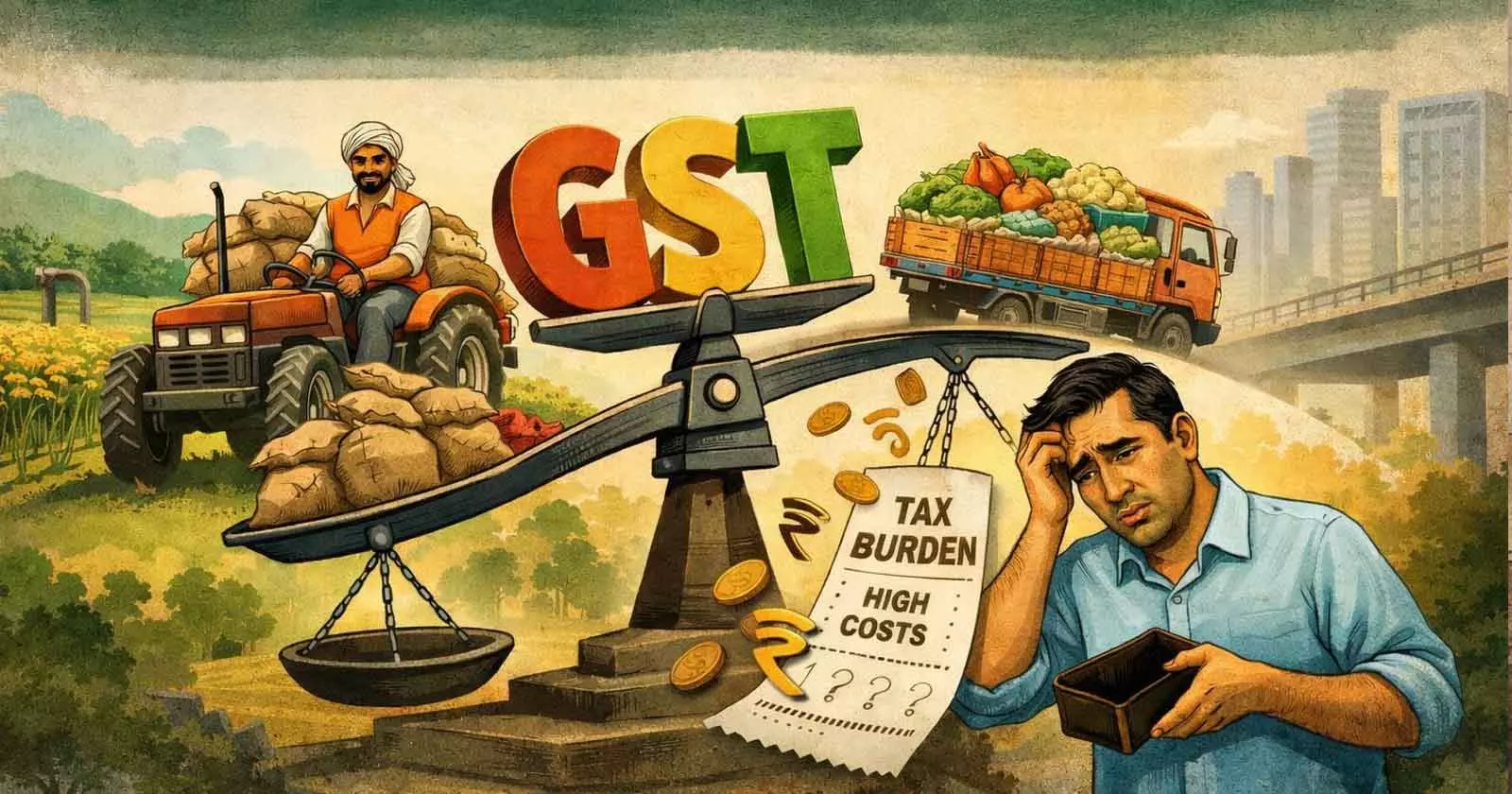
The furrow of a field and the digital ledger of the Goodsand Services Tax (GST) portal might seem like desperate worlds, yet the agribusiness, they are now inextricably linked. As India’s agricultural sector continues to support nearly 42.3 per cent of the population and contributes 18.2 per cent to the national Gross Domestic Product (GDP), the economic landscape has become a choked land where modern concepts lack answers.
For stakeholders in 2026, looking for the GST framework is not merely an administrative task but a necessity defined by complex reverse charges and precise credit re-allocations.
Determining GTA Status
RCM under Section 9(3) Leads to a Shift in Tax Liability on the Recipient
Pursuant to Section 9(3), the Government has engineered a shift in tax incidence, moving the obligation of payment from the supplier to the recipient for specific categories of goods. In the agricultural sector, this mechanism ensures revenue capture from critical commodities such as cashew nuts (not shelled or peeled), bidi wrapper leaves (tendu), tobacco leaves, and raw cotton. When these items are supplied by an agriculturist to any registered person, the recipient is legally deemed the person liable for discharging the tax as if they were the primary supplier.
When the Transporter Pays: The Forward Charge (FCM)
While RCM is often the default for logistics, Notification No. 13/2017 provides a structured elective for transporters to operate under the FCM. For a GTA to pay tax itself, it must be registered under the Act and formally exercise the option to discharge tax on its own supplies. While the buyer usually pays the tax in transport, a transporter can choose to pay the tax themselves.
The evidentiary requirements for this pathway are absolute:
- Registration Requirements: To do this, the transport agency must be registered under the GST Act and formally choose this option.
- Mandatory Paperwork: If a transporter chooses this path, they must issue a proper tax invoice at the correct rates. They must also include a mandatory legal declaration, as found in Annexure III of Notification No. 13/2017, directly on the face of every invoice
Independent paperwork Rules for Buyers under Section 31(3)
Section 31(3)(g) requires the recipient to issue a payment voucher at the exact moment they pay the supplier. These documents serve as the primary statutory evidence required by authorities to prove that the transaction was real and to allow the buyer to claim tax credits later.
Availment of Input Tax Credit on RCM Payments
Mixed Supply Scenarios in the Agricultural Sector
Agribusinesses frequently operate in "mixed" tax scenarios, handling both taxable and exempt products simultaneously. For example, a rice miller may produce taxable rice bran and small-pack rice alongside exempt bulk-packed rice. Under Section 17(2) and Rule 42, common credits, such as those on electricity or machinery repairs, must be apportioned proportionally.
Taxpayers are required to perform these complex calculations monthly, identifying the ineligible portion of credit based on the ratio of exempt turnover to total turnover, and must conclude the year with a mandatory "true-up" to correct any periodic variations.
Conclusion
In 2026, GST compliance in the agricultural sector has transitioned from a back-office task into a fundamental business discipline. The legal shift of tax responsibility to the recipient demands an absolute commitment to documentary transparency and financial liquidity to satisfy the strict "cash-only" payment mandates.
Finally, by adhering to the linear sequence for credit recovery and precisely apportioning common costs, stakeholders can ensure that these complex regulatory requirements provide a stable foundation for navigating the modern economic landscape.
Support our journalism by subscribing to Taxscan premium. Follow us on Telegram for quick updates