

GST on Exports and Imports: Issues and Solutions
The article explains how the Goods and Services Tax (GST) system under the CGST Act, 2017, and IGST Act, 2017, simplifies indirect taxation for international trade.
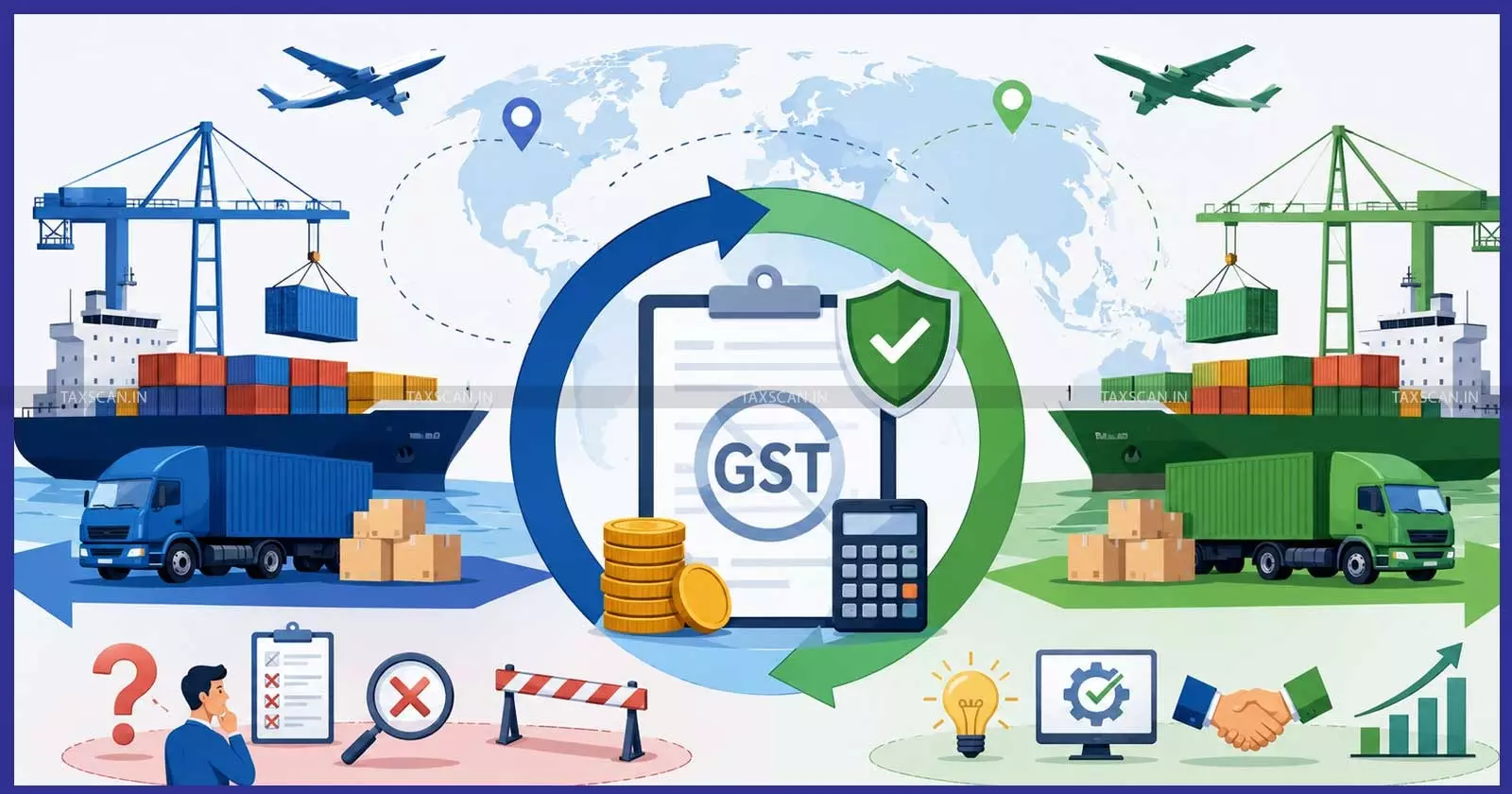
The Goods and Services Tax was introduced in India to make indirect taxation easier. Businesses that trade with other countries often have problems with rules. Exports are considered zero-rated supplies under Section 16 of the Integrated Goods and Services Tax Act, while imports are charged Integrated Goods and Services Tax under Section 5 of the Integrated Goods and Services Tax Act, along with Customs Duty under the Customs Act 1962. Following the rules properly ensures that businesses have money to run smoothly, get refunds quickly, and avoid legal problems.
GST on Exports
- Section 2(5), IGST Act: Defines export of goods as taking goods out of India.
Export of goods means sending goods from India to another country. Such exports are treated as zero‑rated supplies, meaning no GST is charged on them. Exporters can still claim input tax credits for the taxes they paid on purchases used in making those goods. Unlike the export of services, which must meet specific conditions (like payment in foreign currency and supplier location), the export of goods only depends on the movement of goods, not where the exporter or importer is located. So, if goods physically leave India, it counts as an export.
- Section 2(6), IGST Act: Defines export of services with conditions such as the supplier in India, the recipient outside India, the place of supply outside India, and payment in convertible foreign exchange.
Export of services means providing a service from India to a client outside India. For a service to qualify as an export:
- The supplier must be in India.
- The recipient must be outside India.
- The place of supply must be outside India.
- The payment must be received in convertible foreign currency or in Indian rupees if allowed by the RBI.
- The supplier and recipient must be different entities, not just branches or offices of the same company.
In short, export of services depends on where the supplier and recipient are located, where the service is supplied, and how payment is received—unlike goods, which depend only on physical movement.
- Section 16, IGST Act: Declares exports as zero-rated supplies. Exporters can:
- Export under Letter of Undertaking (LUT) without paying IGST (Rule 96A, CGST Rules).
- Pay IGST and claim a refund later under Section 54, CGST Act.
- Match invoice data with shipping bills using ERP reconciliation.
- Verify LUT filing status before export.
- Maintain a refund claim register for timely filing.
- Ensure correct HSN codes under the Customs Tariff Act.
- Include IEC in tax invoices.
- Section 2(10), IGST Act: Defines import of goods as bringing goods into India.
Common Problems
- Shipping bill mismatch with GST returns: discrepancies between customs and GST filings delay refunds.
- Incorrect LUT filing: exporters sometimes fail to renew or file the LUT properly.
- Invoice mismatch in GSTR-1: errors in invoice data lead to rejection of refund claims.
- Delay in refund claim: late filing under Section 54 causes working capital blockage.
- HSN/DGFT classification errors: wrong classification under the Customs Tariff Act leads to notices.
- Missing IEC in invoice: absence of Import Export Code (IEC) violates Foreign Trade Policy requirements.
Solutions
GST on Imports
Import of goods means bringing goods into India from another country. The place of supply is the importer’s location. When goods are imported, Integrated GST (IGST) is charged on their customs‑determined value, in addition to customs duty. The importer must pay this IGST under the reverse charge mechanism, meaning they pay it directly in cash—they cannot use input tax credit to settle this liability.
- Section 2(11) IGST Act: Defines import of service
Import of services means receiving a service in India from a supplier located outside India. For a service to count as an import:
- The supplier is outside India.
- The recipient is in India.
- The place of supply is in India.
Such imports are taxable if they are received for a consideration (payment), even if not for business purposes. The importer must pay IGST under the reverse charge mechanism, and this tax must be paid in cash; input tax credit cannot be used. Also, the importer must register under GST, regardless of turnover.
- Section 5, IGST Act: IGST is levied on imports in addition to Customs Duty under the Customs Tariff Act, 1975.
- Reverse Charge Mechanism (RCM): GST on import of services is payable by the recipient in India.
- Reconcile the Bill of Entry with GSTR-2B.
- Maintain an import register for compliance.
- Verify vendor documentation under Rule 36, CGST Rules.
- Track RCM applicability for imported services.
Common Problems
- IGST credit not reflecting – mismatch between Bill of Entry and GSTR-2B.
- Wrong data in the Bill of Entry – errors in customs documentation delay ITC.
- Delay in filing returns – late GSTR-3B filing blocks ITC utilization.
- Vendor/CHA documentation errors – incorrect records by Customs House Agents cause disputes.
Solutions
Businesses should adopt a compliance framework that includes:
- Proper LUT filing under Rule 96A:
Exporters must submit a Letter of Undertaking (LUT) to export goods or services without paying IGST. It’s proof that they’ll comply with GST rules and complete exports within the allowed time.
- Accurate HSN and GST classification under the Customs Tariff Act.
Goods and services must be correctly classified under the Customs Tariff Act using the right HSN (Harmonized System of Nomenclature) codes. Wrong classification can lead to tax mismatches or notices.
- ICEGATE vs GST reconciliation for imports.
Import data recorded on the ICEGATE portal (Customs) must match GST records. Any mismatch between customs and GST filings can cause errors in tax credit or refund claims.
- Vendor compliance verification.
Businesses should ensure their suppliers are GST‑registered and compliant. Non‑compliant vendors can block input tax credit claims or cause audit issues.
- Documentation trail for refunds and ITC claims.
Maintain complete records—shipping bills, invoices, LUTs, payment proofs, and reconciliation statements to support refund and input tax credit (ITC) claims during audits or scrutiny.
Examples
Export under LUT
- A textile exporter in Tiruppur files LUT under Rule 96A, exports goods without IGST, and later claims ITC refund under Section 54 of the CGST Act.
Import of Machinery
- A manufacturer imports machinery from Germany. IGST is levied under Section 5 of the IGST Act along with Customs Duty under the Customs Tariff Act. ITC of IGST is claimed in GSTR-3B after reconciling with the Bill of Entry.
Import of Services
- An Indian IT company avails cloud services from a US provider. GST is payable under RCM (Section 5, IGST Act) and reported in GSTR-3B.
Judicial and Administrative References
- Amit Cotton Industries v. Principal Commissioner of Customs (2019): Gujarat High Court held that the refund of IGST paid on exports cannot be denied due to procedural lapses if the substantive conditions are met.
- Circular No. 37/11/2018-GST: Clarifies refund procedures for exporters.
- Circular No. 48/22/2018-GST: Provides guidelines for LUT filing.
The Goods and Services Tax rules for exports and imports under the Central Goods and Services Tax Act and the Integrated Goods and Services Tax Act show India's effort to align taxation with trade practices. By treating exports as zero-rated supplies and charging Integrated Goods and Services Tax on imports, the system ensures tax neutrality. Promotes competitiveness. A structured Goods and Services Tax compliance approach supports transparency and efficiency and strengthens India's position in international commerce by enabling smooth cross-border trade. The Goods and Services Tax system helps businesses that trade with other countries by making rules clearer and easier to follow
Support our journalism by subscribing to Taxscan premium. Follow us on Telegram for quick updates
